
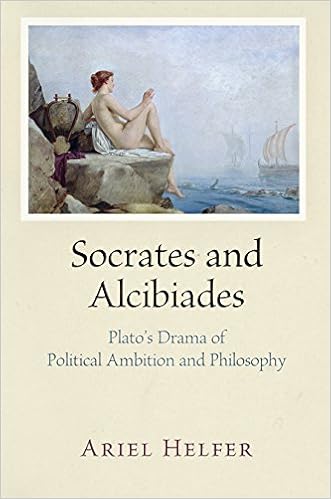
 My first book, Socrates and Alcibiades: Plato’s Drama of Political Ambition and Philosophy (2017, University of Pennsylvania Press) provides an interpretation of Plato’s three major depictions of Alcibiades: Alcibiades, Second Alcibiades, and the final speech in the Symposium. The first two of these, to differing degrees, have seen the authenticity of their Platonic authorship challenged in the last two hundred years or so. In the introduction to my book, I argue for the need for an interpretation that treats all three texts as part of a coherent Platonic narrative that traces Alcibiades’ Socratic education from their first encounter to the eve of the fateful Sicilian expedition.
 My second book, Plato’s Letters: The Political Challenges of the Philosophic Life (2023, Cornell University Press) is a new translation and study of Plato’s Letters. Plato is famous for advocating the political rule of philosophers as a utopian ideal. In his Letters, he reveals that he was often called upon in his own lifetime to implement the political counsel he was known to espouse in books such as the Republic and Laws. But Plato showed much less zeal and much greater circumspection than his devoted followers when it came to bringing political philosophy to bear on practical affairs—and even then, his greatest endeavor, an attempt to reform the powerful Sicilian city of Syracuse, was a conspicuous failure. The conclusion toward which the Letters points us, therefore, is that Plato was much less committed to the idea of philosophic utopia than is often supposed on the basis of his most famous political dialogues. Part of the reason this has gone largely unnoticed, however, is that the Letters has barely ever been recognized as a genuine work of Plato since antiquity. It has been instead been treated as a collection of (forgeries of) scraps that managed to make their way into the Platonic corpus. This book seeks to reopen the debate concerning the authenticity and status of the Letters by engaging scholarly criticism, offering a new English translation of the work for readers who wish to study the Letters as a Platonic unity, and advancing my own interpretation of the work.
My third book, Isocrates and the Socratics, explores the meaning of philosophy in the work of Plato’s illustrious contemporary and alleged rival, Isocrates. Known as a teacher of rhetoric and a writer of model orations, Isocrates consistently refers to his activity throughout his work as “philosophy.” But unlike Plato, who insists that philosophy is the quest to replace mere opinion concerning the greatest things with knowledge, Isocrates insists that philosophy must focus on the development of practical, not theoretical wisdom, on honing the ability to form sound opinions rather than the pursuit of arcane and inefficacious knowledge. Yet Isocrates, in his youth, was himself a companion of Socrates. What led him to produce a presentation of philosophy so different from Plato’s? Did Isocrates turn away from Socratic philosophy without having fully grasped its meaning and purpose? Did his grasp of Socratic philosophy leave him disillusioned? Or does his alternative presentation merely reflect his own, unique rhetorical approach to writing about philosophy? Isocrates and the Socratics will invite readers to wrestle with these questions by making available to them new, literal translations of the four Isocratic texts that most speak to Isocrates’s relationship to Plato and Socrates (Against the Sophists, Encomium of Helen, Busiris, and Antidosis), together with my own interpretive essays.
My work on Isocrates has received research support in the form of a Fellowship from the National Endowment for the Humanities, a Wayne State University Research Grant, and several awards from the Humanities Center at Wayne State, including the Marilyn Williamson Endowed Distinguished Faculty Fellowship. In the 2026 spring semester, I will deliver a series of lectures and seminars on Isocrates as the inaugural M. Richard Zinman Visiting Scholar-in-Residence Fellow at Michigan State University’s James Madison College.
 Ariel Helfer